When you have IBS, it’s easy to assume that the last thing you ate caused your symptoms. But digestion doesn’t happen that quickly, and the timing of IBS symptoms can be a little more nuanced.
So,how long do FODMAPs actually take to impact your gut?
What happens when we eat high FODMAP foods?
Once you eat a meal, it has quite a journey ahead of it.
2-5 hours: Food passes down the oesophagus into the stomach. The stomach acts like a large blender and mixes the meal up into a smoothie type consistency. After this, the stomach will slowly release the smoothie mixture into the small intestine.
2-10 hours: In the small intestine the body absorbs the nutrients that it wants (i.e. carbs, proteins etc) into the blood stream for use.
10-48 hours: Any part of the food that is not absorbed (e.g. FODMAPs, fibre etc) stays in the digestive tract and continues its path to the colon (large intestine) before leaving the body when you open your bowels.

Fun fact:
You can test your own gut transit time by eating corn. Corn is not well broken down and often passes through the intestines intact. Eating corn and then timing how long it takes to see it come out the other end can give you an idea of how long it takes for food to pass through your body.
What about FODMAPs
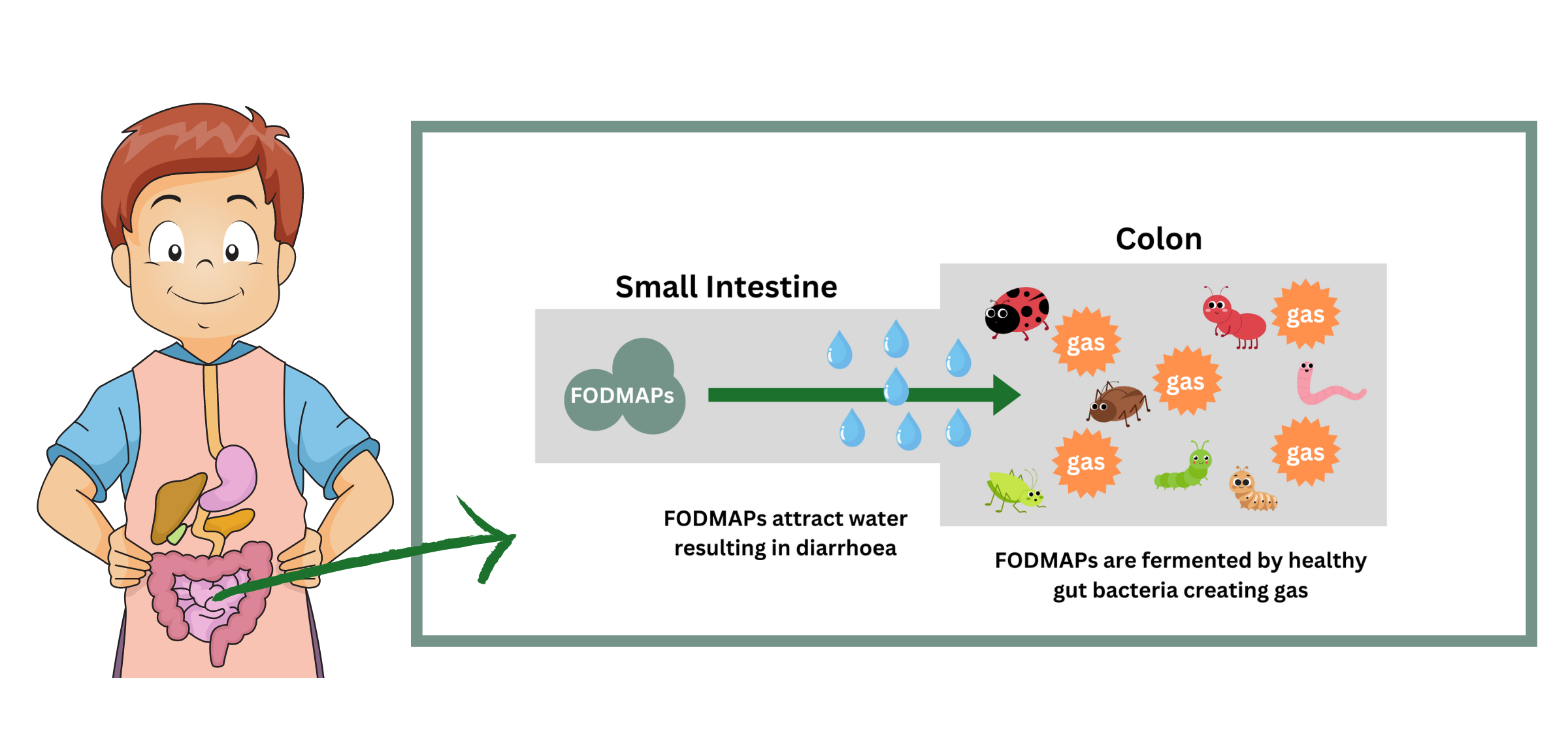
FODMAPs are short chain carbohydrates that by definition do not get digested and absorbed in the small intestine. As they pass through the colon they do 2 things:
- Some FODMAPs draw water into the intestine.
This can increase the amount of fluid within the bowel and contribute to symptoms such as distension, discomfort and diarrhoea in some people. - FODMAPs can be fermented by gut bacteria.
When FODMAPs reach the colon the healthy bacteria that live there ferment them and produce gas as a side effect. This is a completely normal process, but if you have a sensitive gut, the stretching and pressure can be experienced as bloating, pain or cramping.
Importantly, this process takes time.
So, how long do FODMAPs take to impact your gut?
There isn’t one exact number because digestion and gut transit time vary from person to person. As a rule of thumb, FODMAP-related gut sensations occur when the high FODMAP food is in the colon, often somewhere around the 4–24 hour window.
This is why the food you have just eaten isn't necessarily responsible for the symptoms you're experiencing right now.
But that raises another question...
Why do I sometimes get IBS symptoms within 30 minutes of eating?
If you regularly need to run to the bathroom soon after breakfast, lunch or dinner, it can certainly feel as though the meal has travelled straight through you. It hasn’t.
But, it could be your gastro-colic reflex in action.
When food enters your stomach, your stomach sends a message to your bowel telling it that food is on the way and it needs to move things along to make room. If your bowel responds strongly to this message, it can result in a bowel movement.
Importantly, the gastro-colic reflex is a completely normal part of digestion. It can be strongest:
- First thing in the morning, which is why needing to open your bowels soon after breakfast is so common.
- After larger meals, caffeine, alcohol and some spicy foods
- If you’re feeling stressed or anxious
- In people with IBS
So, if you eat breakfast and need to rush to the bathroom 20 minutes later, that doesn’t necessarily tell you much about how well you tolerated breakfast.
Timing can give you clues, but not all the answers
Understanding timing can be really helpful when you’re trying to make sense of your IBS. But it isn’t a perfect tool for identifying food sensitivities. If you’re having flares that don’t seem to make sense, it can be helpful to stand back and look for broad patterns over time rather than individual meals.
Scrap paper recording can be a useful tool here:
- Make your trusted food list and follow it
- If you have a flare, write anything you suspect may have beeninvolved on a scrap of paper and pop it in an envelope.
- Put the envelope on a shelf and keep following your trusted foodslist.
- If it happens again, write on another scrap of paper and add it tothe envelope.
- Once you have several scraps of paper, bring them to a specialistIBS dietitian and see if she can find any patterns.
The important bit? You don't need to investigate every symptom as it happens. Instead treat your symptoms, make a note, put it away and get on with your day.
If your symptoms don't seem to follow the FODMAP rules, this is exactly the kind of detective work I do with my IBS patients.
Find out how I help with IBS here
How long do FODMAP related symptoms last?
Just as time frame for noticing symptoms is on a spectrum, there isn’t one rule for how long they will last either. It can depend on what and how much you’ve eaten, your individual tolerance, your usual bowel habits, gut transit time and how sensitive your gut is at the time.
For some people, symptoms settle relatively quickly. For others, their gut can remain more sensitive for a few days. Remind yourself that it will pass, and focus on what you can do to feel more comfortable in the meantime
I have tips on how to manage a flare here
When figuring it out yourself starts getting complicated
If you’ve been managing IBS for a while, you’ll probably know that real life doesn’t always fit neatly into a 4–24 hour window. You might eat the same food twice and feel different each time. You likely tolerate some foods in a small amount but not a larger amount. Or you might have symptoms when you can’tidentify anything different about what you’ve eaten.
That doesn’t necessarily mean you’re making a mistake. Food sensitivities can absolutely be part of IBS, and also food is only one part of the picture. Your overall FODMAP load, individual tolerance, bowel habits, gut sensitivity, sleep, stress, hormones and the gut-brain connection can all influence how your gut feels.
This is where constantly trying to match individual symptoms with individual foods can become more confusing than helpful.
Still trying to work out what you canand can’t eat?
If you're constantly trying to connect your symptoms to what you've eaten, removing more foods and still feeling confused about your IBS, you probably don't need another food list. You need someone to help you work out which foods actually matter, what else might be influencing your symptoms and which things you can stop worrying about.
That's what I help my IBS patients do.
Together, we'll make sense of what's happening and turn it into a clear, practical plan, so you know what to eat, what to do when symptoms happen and how to get back to enjoying food without unnecessary restriction.
Find out how I help with IBS here